
تماس فوری
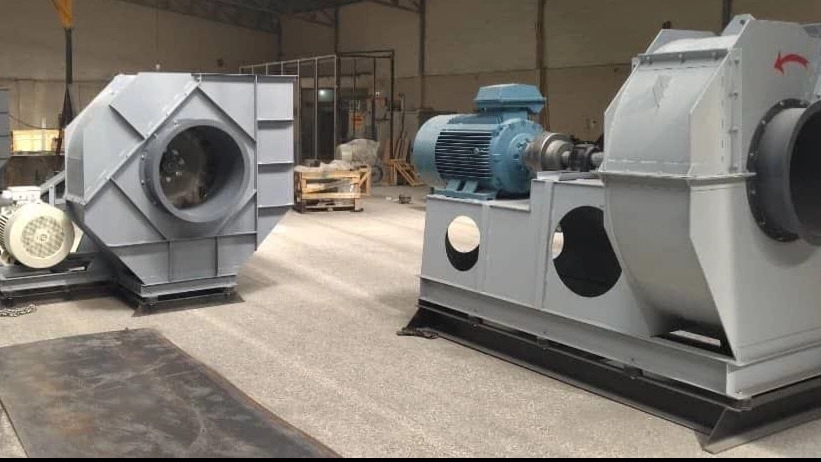
Construction of fan centrifuges in ventilation surfaces; Air flow engineering and high efficiency
Trust Ventilator to manufacture high efficiency industrial centrifugal fans. Engineering design, dynamic balance and the best material for professional air conditioning.
Introduction
In advanced industries, optimal ventilation goes beyond the simple rotation of a propeller. Centrifuges are the beating heart of industrial ventilation systems, dust collectors and material transfer systems. Making a quality fan centrifuge requires knowledge of aerodynamics, material engineering and precise manufacturing technologies. With years of experience in the production of industrial ventilation equipment, "Safahan Ventilation" follows this process from the engineering design stage to the final assembly with strict standards.
What is a centrifugal fan and how does it work?
Fan centrifuge is a device that converts mechanical energy into kinetic energy in air flow. Air enters the fan through the propeller and is directed to the outlet with high pressure and speed due to centrifugal force. The main difference between these fans and axial fans is their ability to create higher static pressure, which makes them ideal for long ducts and high resistance environments.
Engineering steps in the construction of fan centrifuges in ventilation surfaces
Manufacturing of a standard fan centrifuge in the ventilation fields is carried out in a completely controlled process to ensure long-term and silent operation.
1. Aerodynamic design and technical calculations
The first step is to select the type of impeller and design the dimensions based on the required flow rate (CFM) and static pressure. Using simulation software, our engineers calculate the best blade angle to reduce air turbulence and increase efficiency.
2. Cutting and making the body (Casing)
The body of the device, which is responsible for guiding the air flow, is made using steel or galvanized sheets with engineered thicknesses. In ventilation surfaces, accuracy in cutting and shaping the body guarantees leak-proofness and reduction of device vibrations.
3. Impeller manufacturing and welding
The propeller is the most sensitive part of the fan. The vanes must be connected to the main disk by precise and high-strength welding so that they do not deform or detach at very high speeds. The type of connection of the blades to the hub plays a vital role in the life of the device.
4. Dynamic and static balance (critical stage)
This stage is the distinguishing feature of ventilation surfaces. Each propeller must be carefully aligned after manufacture. Imbalance, even by a few grams at high speeds, causes severe vibration, damage to the bearings, and eventually breaking the fan. We use advanced devices for dynamic balancing to deliver a device with near zero vibration.
Types of centrifuges and production fans
Depending on the application, we produce different types of propellers:
- Backward impellers: Suitable for systems that require high efficiency and less noise and are ideal for transporting clean to slightly dusty air.
- Forward impellers (Forward): Suitable for high air volume with low pressure, usually in HVAC systems.
- Radial impellers: Designed for applications heavy industrial, material transfer, coarse particles and highly polluted air that require abrasion resistance and strong structure.
Why ventilating surfaces?
Choosing a reputable manufacturer for your centrifugal fan will greatly reduce your ongoing maintenance costs. We are by your side in Safahan ventilation based on the following:
A guide to selecting a centrifugal fan for dust collection and industrial filtration systems in ventilation surfaces
Introduction
In many industrial units, dust control is not just a matter of cleanliness; Rather, it is directly related to product quality, employee health, equipment life, and production line efficiency. In the meantime, Fan Centrifuge plays the role of the heart of the dust collection and industrial filtration system. If the fan is not chosen correctly, even the best bag filter, scrubber or cyclone cannot perform well.
In this article, we will help you know what type of technical centrifuge is most suitable for an industrial dust collection system and what points to consider when buying or designing.
What role does the fan centrifuge play in the dust collection system?
Centrifuge fan has the task of sucking the polluted air from the point of dust production and directing it to the right path through the channel, filter or separator. This fan should produce sufficient flow rate and provide necessary static pressure to pass air through filters, channels and connections.
If the fan pressure is less than the required value, the suction will be weak. If it is too high, energy consumption will increase, wear will increase and filters may be damaged. Therefore, choosing the right one is very important.
The most important criteria for choosing a fan centrifuge
1. Required air flow
The first and most important parameter is the amount of air that must be moved in the system. The discharge is usually determined based on the volume of the space, the number of suction points, the type of process and the intensity of dust production.
If the flow rate is selected lower than the actual requirement, the dust will not be collected properly. If it is too much, energy is wasted and useful or light particles may also be removed from the system.
2. System static pressure
In dust collection systems, air must pass through different paths such as channels, elbows, dampers, bag filters or cartridge filters. These paths create resistance and the fan must be able to overcome this resistance.
The longer the channel, the more connections and the denser the filter, the higher the required pressure. For this reason, centrifugal fans are usually better for this application than axial fans.
3. Type of particles and nature of contamination
The type of dust is very decisive. Particles can be light, heavy, sticky, abrasive, hot or even flammable.
For example:
- Wood dust with light and bulky particles
- Abrasive metal dust
- Cement or plaster particles with high density
- Chemical vapors and particles
- Hot dust in foundry or furnace industries
Each of these items changes the type of blade, body material and suitable speed of the fan.
4. Type of fan blade
For dust collection systems, the choice of propeller is very important.
Radial propeller
This type of propeller is very suitable for transporting particles, heavy dust and polluted air. It has high resistance against clogging and wear and is used in many industrial systems.
Enter the butterfly
This type is suitable for higher efficiency and less noise and is widely used in filtration systems with medium pollution.
Forward license
This type is mostly used in low pressures and high flow rates and is usually not the first choice for heavy dust collection systems.
What kind of technical centrifuge is more suitable for dust collector?
In most industrial projects, if you are dealing with heavy dust, abrasive particles, or long runs, Radial or Backward Fan Centrifuges are the best choice.
But if your system works in an environment with moderate pollution and your goal is general air filtration or production hall ventilation, a high-efficiency backward fan may be more suitable.
Material of the body and blade in the dust collector fan
Fan body
The body should be selected according to the type of particles and environmental conditions. In corrosive or wet environments, it is important to use resistant galvanized sheet or coated steel. In certain industries, stainless steel can also be a suitable option.
fan blade
blades must be resistant to wear, impact and accumulation of particles. In the dust collector industry, the design of the blade should be such that less particles sit on it and the possibility of clogging is reduced.
Common mistakes in choosing a fan centrifuge
Fan selection based on price only
One of the most common mistakes is buying a cheap fan without considering the actual pressure and flow rate of the system. Such a choice usually leads to a drop in performance and subsequent costs.
Ignoring filter pressure drop
Many buyers only consider the channel path and do not calculate the pressure drop caused by the filters. This issue weakens the suction of the system.
Choosing the wrong license
If the type of propeller is not compatible with the nature of the particles, the fan will quickly get clogged, wear or lose efficiency.
Ignore the installation conditions
Installation location, vibration, access for service, weather conditions and physical space are important factors in fan performance.
How does the right choice reduce costs?
The principled choice of centrifugal fan not only leads to better performance, but also reduces costs in the long run. A properly selected fan:
- Consumes less electricity
- Increases the life of bearings and electric motors
- Puts less pressure on filters
- Reduces the need for repairs
- Increases dust collection efficiency
The advantage of choosing ventilation surfaces
Safahan Ventilation, with an engineering perspective on the design and construction of centrifugal fan, can suggest the right fan according to the actual conditions of each project. This means that your choice is not just a ready-made product, but a technical solution.
Advantages of cooperation with the ventilation surfaces
- Design based on actual flow and pressure
- Choosing the type of propeller according to pollution
- Customized manufacturing possible
- Paying attention to efficiency and energy consumption
- Technical support for better selection