
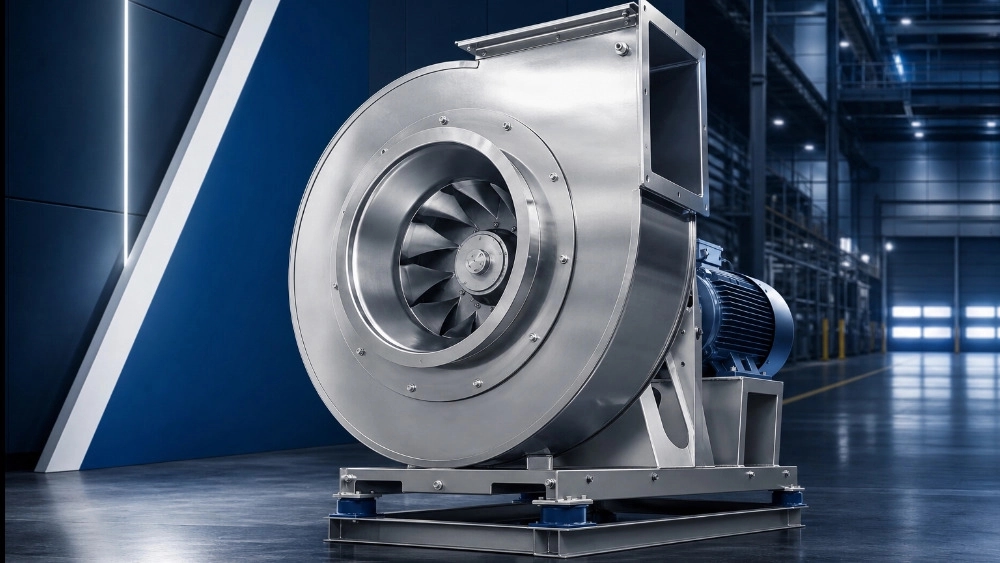
production of centrifugal fan in ventilation surfaces; A comprehensive guide to selection and technical specifications
Why are centrifugal fans essential for industry?
Introduction and analysis of centrifugal fans
1. Backward Curved Centrifugal Fan
2. Forward Curved Centrifugal Fan
3. Radial blade centrifugal fan
Selection Guide: Which fan is best for your needs?
- In terms of efficiency: If energy saving is your first priority, Backward fans are the best option due to their high efficiency. Forward and radial fans have average and lower efficiency, respectively.
- In terms of pressure generation: If your system has long ducting or powerful filters, radial fans are suitable for generating very high pressure and backward fans for medium to high pressure.
- In terms of sound level: If you have sound restrictions, forward fans They have the quietest performance, while radial fans usually produce more noise due to their industrial structure.
- In terms of environmental conditions: For clean environments, backward and forward fans are suitable. But in polluted, dusty or suspended particle environments, only radial fans are recommended due to their resistance to blockage and wear.
Main components and production standards in ventilation surfaces
- Shelter (Housing): using ST37 steel sheets or stainless steel (304/316) with CNC laser cutting to increase strength.
- Impeller: All impellers to prevent vibration and early failure of bearings, according to international dynamic and static balance standards.
- Electric motor: Use of industrial motors with IP55 protection class and Class F insulation class, which guarantees the useful life of the equipment.
- Power transmission system: The possibility of providing direct connection (Direct Drive) for maximum efficiency and belt and money connection (Belt Drive) for precise adjustment of the fan speed.
Calculation formula of electric motor power
Industrial applications of Safahan centrifugal fan for ventilation
- Heavy industries: Tiles and ceramics, cement and stone (for dust collection).
- Food industries and restaurants: Discharge of fat, smoke and heavy vapors in industrial kitchens.
- Chemical industries: Manufacture of anti-corrosion fans with special or steel coatings.
- Building facilities: Parking lots (gas discharge) CO), cold stores and warehouses.